export@siegmachine.com
+86-182 1718 6723


Product name:three roller mill
Model:TRL series
Fucnction:fine grinding for viscous materials
Apllication:inks,coating,metal paste,cosmetics
(SIEGMA-Focus on mixing&grinding technology)
Introduction:
A three roll mill is a grinding and dispersing machine equipped with three horizontal and parallel rollers. Because the three rollers run at different speeds and directions, they generate strong shear forces that grind, disperse, and mix high-viscosity materials. The TRL series three roll mill is widely used for paste grinding in printing inks, high-performance ceramic pastes, cosmetics such as lipstick, plastic adhesives, carbon and graphite, high-viscosity coatings, resins, ointments, dental fillers, adhesives, sealants, silver paste, aluminum paste, and glass paste, as well as food products such as chocolate paste and guar gum.
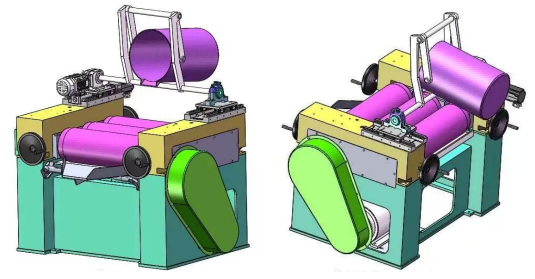
Working Principle of three roller mill:
A three roll mill consists of three horizontally mounted rollers, usually made of hardened alloy steel or ceramic. The rollers rotate at different speeds, with the fastest roller at the discharge side. The material is fed between the rear and middle rollers, then transferred to the gap between the middle and front rollers. Because the rollers rotate at different speeds, the material experiences strong shear and friction forces that break down agglomerates and disperse particles. A scraper blade removes the processed paste from the front roller.
The grinding process follows these steps:
1.Feed the paste – high-viscosity material is loaded into the hopper.
2.Pass through the rear gap – the material is pulled between the rear and middle rollers.
3.Transfer to the front gap – the material moves to the gap between the middle and front rollers.
4.Shear and dispersion – different roller speeds create strong shear forces that break down agglomerates.
5.Scrape and discharge – a scraper blade removes the finished paste from the front roller.
6.Repeat if needed – the paste can be passed through again for finer dispersion.
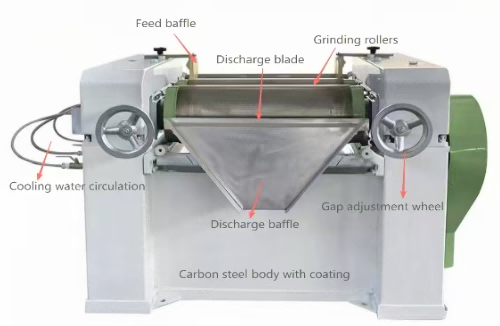
Technical Specification:
| Model | Roller Dia | Roller Length | Motor |
| TRL-65 | 65 mm | 125 mm | 0.75 kW |
| TRL-150 | 150 mm | 300 mm | 2.2 kW |
| TRL-260 | 260 mm | 675 mm | 7.5 kW |
| TRL-405 | 405 mm | 810 mm | 15 kW |
| TRL-405P | 405 mm | 1000 mm | 22 kW |
TRL-405P is the extended version of TRL-405, with longer rollers and higher motor power for increased capacity.
Note: The above data is for reference only. Actual grinding results may vary depending on material properties and formulation. Please contact our process engineers for a suitable model recommendation.
Roll material – Hardened steel, ceramic, or stainless steel
Feeding method – Manual or hydraulic
Sanitary design – Mirror polish, no dead corner
Explosion-proof – Ex d IIB T4 motor
Tell us your product and compliance requirement. We will confirm the right configuration before quotation.
Typical Application:
Printing ink – solvent-based and offset ink dispersion
Cosmetics – lipstick, cream, and ointment
Conductive paste – silver paste, aluminum paste, glass paste
Adhesives and sealants – plastic adhesives, sealants
Carbon and graphite – carbon paste, graphite paste
Food – chocolate paste, guar gum
Resin and coating – high-viscosity resin, high-viscosity coating
Pharmaceutical – ointment, toothpaste filler
Pigment – pigment paste
Choosing the right three roll mill depends on four factors:
1. Material viscosity. Three roll mills are designed for high-viscosity paste, typically above 10000 cps. For low or medium viscosity products, a bead mill or colloid mill is more suitable.
2. Target fineness. For 10–50 μm, a standard three roll mill with hardened steel/SS/ceramic rollers is sufficient.
3. Metal sensitivity. For electronic paste, cosmetic, and pharmaceutical products, ceramic rollers prevent metal contamination from steel rollers.
4. Production scale. Lab and sample testing use 65–100 mm rollers. Pilot production uses 150 mm. Full production uses 260–405 mm rollers with hydraulic material feeding.
What is the difference between a three roll mill and a bead mill?
A three roll mill handles high-viscosity paste above 20,000 cP. A bead mill handles low to medium viscosity liquid below 20,000 cP.
What is a three roll mill used for?
It is used for grinding, dispersing, and mixing paste materials such as printing ink, pigment, cosmetic, adhesive, and conductive paste.
What particle size can a three roll mill achieve?
20–50 μm with one pass. Below 10 μm with ceramic rollers and multiple passes.
How do I set the roller gap?
The rear gap is set wider than the front gap. Reduce the front gap and increase the number of passes for finer grinding.
What is the price of a three roll mill?
Depends on roller size, material, and configuration. Send your requirements for a quote within 24 hours.
What maintenance does a three roll mill need?
Check roller surface for wear weekly, inspect the scraper blade for even contact, and lubricate the bearings according to the schedule.
Tell us your product, viscosity, and target fineness. We will recommend the right model and provide a quotation within 24 hours.
Contact: Lucas Shu
Phone: +86-182 1718 6723
E-mail: export@siegmachine.com
Whatsapp:+86-182 6708 5695
Add: NO.556,caofeng road,Jiading district,Shanghai, China