export@siegmachine.com
+86-182 1718 6723
Printing ink production involves six main steps: raw material preparation, batching, mixing, grinding, inspection, and packaging. The grinding stage is the most critical for ink quality, and the equipment used depends on the ink type: offset ink uses a three roll mill or a pin-type bead mill, while flexographic ink is better suited to a basket mill.
1. Preparation. Process the main raw materials: pigments, binders, and fillers. Pigments require processing, and binders need refining to meet ink manufacturing requirements.
2. Batching. Place pigments, binders, and auxiliaries into a dedicated container according to the ink formula. Batching determines the ink's properties and directly affects printability.
3. Mixing. Use mechanical action to mix solid pigment powder with the binder. This wets the pigment, removes air and moisture, and achieves coarse dispersion.
4. Grinding. Further disperse the pigment in the binder to meet printing requirements. Different ink types require different grinding levels. This is where equipment selection matters most.
5. Inspection. Check color and fineness against design requirements.
6. Packaging. Fill qualified ink into drums, avoiding gaps and bubbles to reduce oxidation and skinning.
Throughout the process, quality and environmental indicators must be strictly controlled to ensure product safety, stability, and reliability.
The grinding stage is where ink manufacturers make the most important equipment decision. Three types of mills are commonly used, and the choice depends mainly on ink viscosity and batch size.
Offset ink (high viscosity). Offset ink is highly viscous and paste-like. A three roll mill is the traditional choice because it handles high-viscosity paste well and gives precise control over fineness. A pin-type bead mill can also be used, and some producers combine both: the three roll mill for final dispersion, the bead mill for pre-grinding. This combination improves efficiency, because a three roll mill alone has relatively low grinding efficiency.
Flexographic ink (good flowability). Flexographic ink has lower viscosity and better flowability. A basket mill is a strong choice here, because it grinds and disperses in the same tank and is easier to clean between batches.
Batch size and color changes. Ink production usually involves small batch sizes and frequent color changes. This favors equipment that is easy to clean and quick to switch over. A basket mill has an advantage here, since the grinding basket can be lifted out and flushed without emptying the entire system.
| Ink type | Viscosity | Recommended mill | Why |
| Offset ink | High | Three roll mill, or pin-type bead mill | Handles high-viscosity paste |
| Gravure ink | Low | Bead mill | Continuous, high-volume grinding |
| Flexographic ink | Low–medium | Basket mill | Easy cleaning, batch production |
| Screen printing ink | Medium–high | Three roll mill or bead mill | Depends on fineness and batch size |
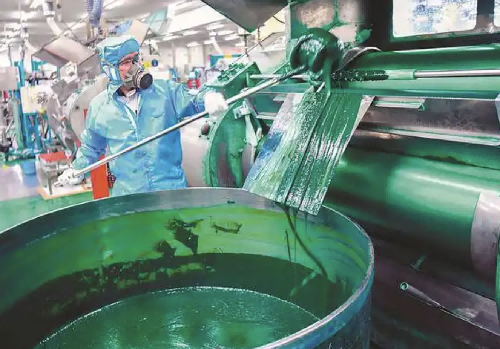
Ink manufacturing is a multi-product, multi-color business. A single production line may run dozens of formulas per month, with frequent changeovers. This creates three requirements that a basket mill meets well:
Easy cleaning. The basket lifts out of the tank, so cleaning between colors takes less time.
Batch flexibility. It handles small to medium batches without the setup required for continuous equipment.
Combined dispersion and grinding. Pre-dispersion and fine grinding happen in one vessel, reducing equipment and floor space.
For high-viscosity offset ink, a three roll mill is still the standard. But for flexographic and liquid inks, a basket mill often gives a better balance of quality, cleaning speed, and cost.
What equipment is used to grind printing ink?
Three roll mills, bead mills, and basket mills are the most common. The choice depends on ink viscosity and batch size.
Why do some ink producers use both a bead mill and a three roll mill?
A bead mill pre-grinds the pigment, and a three roll mill finishes the dispersion. This combination is more efficient than using a three roll mill alone.
Is a basket mill suitable for offset ink?
A basket mill works better for lower-viscosity inks such as flexographic ink. For high-viscosity offset ink, a three roll mill or pin-type bead mill is more suitable.
Tell us your ink type, viscosity, and batch size. Our engineers will recommend the right mill and provide a quotation within 24 hours.
View our three roll mill, bead mill, and basket mill for specifications and models.
Contact: Lucas Shu
Phone: +86-182 1718 6723
E-mail: export@siegmachine.com
Whatsapp:+86-182 6708 5695
Add: NO.556,caofeng road,Jiading district,Shanghai, China