export@siegmachine.com
+86-182 1718 6723
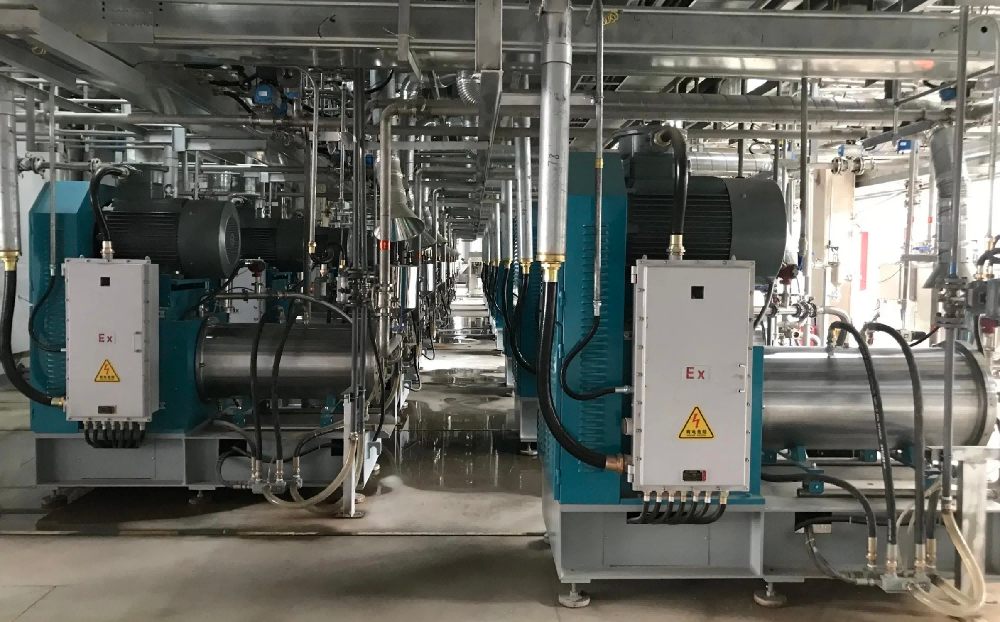
A bead mill is a grinding machine that uses small grinding media, typically zirconia or glass beads, to reduce particles to micron or sub-micron size. It works by agitating the beads at high speed inside a grinding chamber, creating impact and shear forces that break down particles in liquid and semi-liquid materials.
A bead mill consists of a cylindrical grinding chamber filled with grinding media. A rotating shaft with discs or pins agitates the media at high speed. The material is pumped through the chamber, where it is ground by the collision and shear between the beads. A separator at the outlet keeps the media inside while allowing the ground product to flow out. A cooling jacket controls the temperature during continuous operation.
The process follows these steps:
Pre-mix the material – prepare the product to a uniform consistency.
Feed into the pump – transfer the material into the feeding pump.
Pump into the grinding chamber – the material enters the main grinding chamber.
Add grinding media – zirconia or glass beads are added in the required amount.
High-speed collision – particles collide at high speed, generating shear, mixing, and emulsifying effects.
Reach required fineness – grinding continues until the target particle size and dispersion are reached.
Discharge – a separator retains the media and discharges the processed product.
There are three main types of bead mills, distinguished by the shape of the agitator inside the grinding chamber.
Disc type uses multiple flat discs on the shaft. It is suitable for medium to high viscosity products such as paint, ink, and pigment paste.
Pin type uses cylindrical pins instead of discs. It creates stronger turbulence and is suitable for high-flow, low to medium viscosity products such as pesticide and chemical.
Turbo type uses turbine-shaped agitators. It provides the highest energy density and is used for sub-micron grinding, such as battery slurry and nano ink.
| Type | Best viscosity | Throughput | Grinding fineness | Typical application |
|---|---|---|---|---|
| Disc | Medium–high | Medium | 5–30 μm | Paint, ink, pigment |
| Pin | Low–medium | High | 5–20 μm | Pesticide, chemical |
| Turbo | Low–medium | Medium–high | Below 1 μm | Battery, nano ink |
Bead mills are used in paint, ink, pesticide, cosmetic, battery, and chemical production. The two most common applications are paint and printing ink, where fine dispersion directly affects product quality.
Paint and coating. Bead mills disperse pigment and filler particles in both water-based and solvent-based paint. The target particle size is typically 10–30 μm. A bead mill can process high-solid-content paint continuously, which is difficult to achieve with a batch mixer alone.
Printing ink. Offset and gravure inks require pigment particles below 10 μm for consistent color and print quality. With 0.3–0.5 mm zirconia media, a bead mill can reach sub-micron dispersion for high-end ink applications.
Other applications include pesticide formulation, cosmetic cream, battery slurry, and chemical production.
A bead mill uses a sealed horizontal chamber for continuous grinding, suitable for high-volume production. A basket mill combines grinding and dispersion in one vessel, better for multi-product batch production and easier cleaning.
| Bead mill | Basket mill | |
|---|---|---|
| Grinding mode | Continuous | Batch |
| Best for | High-volume production | Multi-product, multi-color |
| Cleaning | More complex | Easier |
| Typical use | Paint, ink, pesticide | Paint, ink, color paste |
Standard configuration achieves 2–50 μm. With 0.3–0.5 mm zirconia beads and a turbo type mill, sub-micron (below 1 μm) is achievable. Final particle size depends on media size, grinding time, and material hardness.
What is a bead mill used for?
It is used for fine grinding and dispersion of paint, ink, pesticide, battery slurry, cosmetic, and chemical products.
What is the difference between a bead mill and a three roll mill?
A bead mill handles low to medium viscosity liquid below 20,000 cP. A three roll mill handles high-viscosity paste above 20,000 cP.
How do I choose grinding media size?
Start with 1–2 mm beads for coarse grinding, then switch to 0.3–0.5 mm for fine grinding. Smaller beads give finer particles but lower throughput.
What is the price of a bead mill?
Depends on capacity, chamber material, and configuration. Send your requirements for a quote within 24 hours.
Tell us your material, target particle size, and required capacity. Our engineers will recommend the right model and provide a quotation within 24 hours.
View our FGS series bead mill for specifications and models.
Contact: Lucas Shu
Phone: +86-182 1718 6723
E-mail: export@siegmachine.com
Whatsapp:+86-182 6708 5695
Add: NO.556,caofeng road,Jiading district,Shanghai, China