export@siegmachine.com
+86-182 1718 6723
Paint, coating, and ink production mixes solid pigment and filler particles into a liquid phase (solvents, resins, or binders, plus additives) to form a uniform, fine suspension. The goal is not just mixing — it is breaking down particle aggregates and dispersing them stably in the final product.
This article focuses on dispersion and grinding technology. Formulation design belongs to the chemist; equipment selection belongs to the process engineer. Both affect final product quality, but this guide covers the equipment side.
If you are choosing equipment for a new production line, contact us with your product type and target fineness. We will recommend the right dispersion and grinding setup.
The primary particles of pigments and fillers are extremely fine, usually 0.01–2 μm. But during processing and storage, these primary particles bond into aggregates (secondary particles). The aggregate size can grow to 100 μm or more.
If these aggregates are not broken down, the pigment cannot develop its full tinting power and hiding power. The final film will show color unevenness, poor gloss, and lower durability.
De-aggregation and stable dispersion are therefore the core tasks of paint, coating, and ink manufacturing.
Two factors determine dispersion quality:
1. High-efficiency dispersion and grinding equipment. The right equipment breaks down aggregates to the required fineness and keeps them dispersed.
2. High-quality raw materials and a good formulation. Even the best equipment cannot compensate for poor raw materials or a poorly designed formula.
This article focuses on the first factor. Formulation is the chemist's domain.
Step 1: Pre-dispersion. This step mixes the pigment into the liquid phase and provides initial dispersion. It is a preparatory step for fine grinding. The most common equipment is a high-speed disperser or dissolver.
Not every product needs fine grinding. Paints and coatings with no fineness requirement, or those using expensive super-fine raw materials, can reach the final product after pre-dispersion alone.
Step 2: Grinding and dispersion. This is where aggregates are broken down to the target particle size. Common equipment includes vertical sand mills, horizontal sand mills, three roll mills, and basket mills.
Step 3: Adjusting. After grinding, the batch is adjusted to the final specification — viscosity, color, and other properties.
Step 4: Filtration and packaging. The finished product is filtered and filled into containers.
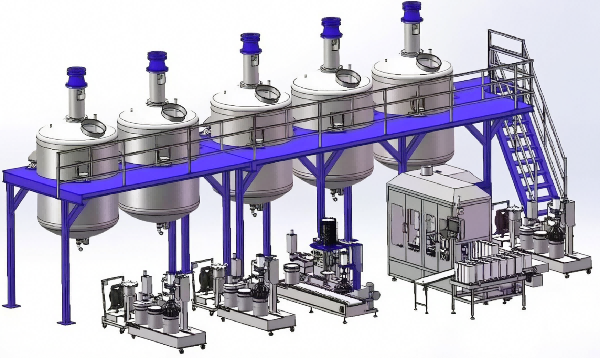
If you are unsure which grinding equipment suits your product, send us your material type, viscosity, and target fineness. We will match the right mill to your process.
The grinding step is where equipment selection matters most. The choice depends on viscosity, batch size, and target fineness.
Vertical sand mill – suitable for small to medium batches and lower viscosity products. Simple structure, lower cost.
Horizontal sand mill – suitable for continuous, high-volume production. Higher grinding efficiency and finer dispersion than vertical type.
Three roll mill – suitable for high-viscosity paste above 20,000 cP, such as offset ink and pigment paste. Precise gap control for fine dispersion.
Basket mill – combines dispersion and grinding in one vessel. Best for multi-product, multi-color batch production with frequent changeovers.
If your product is high-viscosity paste, a three roll mill is usually the right choice. If your product is low to medium viscosity liquid, a bead mill or basket mill is more suitable. Send us your viscosity and batch size and we will confirm.
For high-viscosity materials, different mixers are used. Common types include butterfly mixer, dual-shaft high-speed disperser, compound agitators (high speed + low speed + scrapers), frame mixer, anchor mixer, planetary mixer, and ribbon mixer.
These machines are often combined in one system. For example, a dual-shaft disperser may combine a high-speed shaft for dispersion and a low-speed anchor for bulk mixing. A planetary mixer may combine revolution and rotation for uniform mixing of high-viscosity paste.
If your material is difficult to mix or disperse with standard equipment, contact us with your viscosity and batch size. We will recommend the right combination.
Most dispersion and grinding equipment can be customized based on actual production requirements. Common customization options include:
Mounting type – floor type or top-mounted type (with reactor and platform)
Vacuum operation – for avoiding pungent solvents and air bubbles
Scraper – for high-viscosity materials
Heating or cooling – steam or electrical heating, water circulation cooling via jacket
If you need a customized configuration, send us your process conditions and we will confirm feasibility and lead time.
Skipping pre-dispersion and feeding pigment directly into the mill
Using a high-speed disperser for a product that needs fine grinding
Choosing a vertical sand mill for high-viscosity paste
Ignoring aggregate size in raw materials
Not adjusting viscosity after grinding
Using one mill for both low-viscosity and high-viscosity products
Tell us your product type, viscosity, target fineness, and batch size. Our engineers will recommend the right equipment combination and provide a quotation within 24 hours.
View our three roll mill, bead mill, and basket mill for specifications and models.
Contact: Lucas Shu
Phone: +86-182 1718 6723
E-mail: export@siegmachine.com
Whatsapp:+86-182 6708 5695
Add: NO.556,caofeng road,Jiading district,Shanghai, China